Opening Range Breakout Strategy: How It Works and How to Trade It Properly
How the opening range breakout works, the details that decide whether it pays, and how the Raw Edge ORB card builds, backtests and automates it on MT5.
The opening range breakout, usually shortened to ORB, is one of the oldest intraday strategies there is, and one of the easiest to explain. Mark the high and low of the first few minutes after a market opens. Then trade whichever side breaks.
That simplicity is why so many traders start with it. It is also why it is so easy to test badly. An ORB has very few moving parts, so each one carries a lot of weight: which clock you measure the open on, how long the range runs, when your order is actually working, and what price the backtest says you got. Get those right and you find out quickly whether the idea works on your market. Get them wrong and the backtest describes a strategy nobody could trade.
This guide covers how the strategy works, the details that decide the result, and how the Opening Range Breakout card in Raw Edge handles each of them.
How the opening range breakout works
A market's open is the busiest moment of its day. Orders that built up overnight hit the book at once, news from the closed hours gets priced in, and for a while price swings around as buyers and sellers argue about where it should be. The opening range is the record of that argument: the highest and lowest prices traded in the first 15, 30 or 60 minutes.
The idea behind the ORB is that a clean break out of that range means one side has won the argument for the day. You do not try to predict which side. You put an order on both and let the market choose.
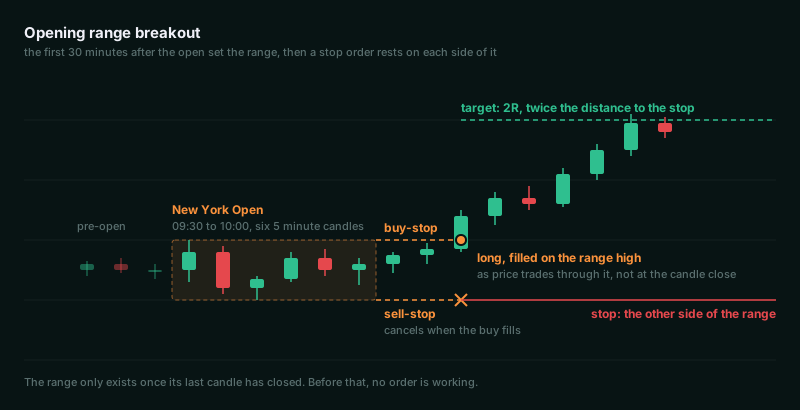
The classic rules:
- Pick the open. The New York cash open at 09:30 for US indices, Frankfurt at 09:00 for the DAX, London at 08:00 for the FTSE and sterling.
- Pick the range length. The first 15, 30 or 60 minutes are the usual choices.
- Place the orders when the range completes. A buy-stop just above the range high and a sell-stop just below the range low.
- Take the first break. Whichever order fills is the trade, and the other one is cancelled.
- Stop on the other side of the range. The range height becomes your risk, so a 2R target sits two range heights beyond the entry, which is the traditional ORB projection.
- Set a cut-off. If nothing has broken by a set time, there is no trade that day.
When it works, and when it does not
The ORB is a trend-day strategy. On a day when the open sets the tone and price runs in one direction, it catches the move early with a small, clearly defined risk. On a quiet, two-way day, price pokes out of the range, triggers your order and drifts back in, and you take a loss.
So the results usually have a particular shape: plenty of small losses and scratch trades, paid for by a smaller number of big days. The win rate is often under half. That is fine if the winners are large enough, and it is exactly why the details below matter so much. When the average loss is small and fixed, small errors in fill price or timing are a large share of it.
It also works best where the open is a genuine event. Index CFDs at their cash open, and currencies at the London open, have real opening auctions behind them. A market that trades all night with no particular burst at your chosen time gives the range much less meaning.
The details that decide the result
Range length
A short range gives more trades, a tighter stop and more false breaks. A longer range gives fewer trades, a wider stop and cleaner signals. There is no correct answer in the abstract. Test a few, and prefer a length whose neighbours also work. If 30 minutes is good and 15 and 45 are both poor, that is noise, not a setting.
Which clock you measure the open on
This one catches a lot of people out. The New York open is 09:30 New York time, which is 14:30 UTC in winter and 13:30 UTC in summer. If your strategy defines the range in UTC or in your broker's server time, it will be an hour out for part of every year: you will spend months measuring 10:30 to 11:00 and calling it the open.
It gets worse around the clock changes. The US and the UK switch on different weekends, so for a few weeks each spring and autumn the gap between London and New York is four hours instead of five. A backtest built on a fixed time quietly mixes two different setups and reports the average.
When the order is working
A real ORB trader places stop orders the moment the range completes. The fill happens as price trades through the level, not when a candle closes beyond it.
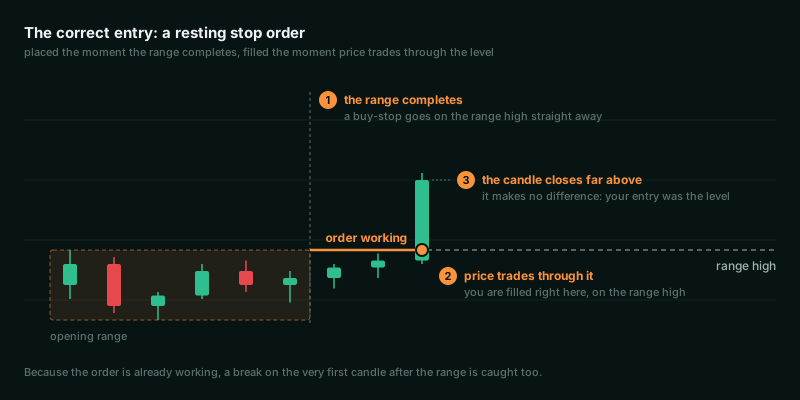
That difference is where many backtests go wrong. The common shortcut is to check whether a candle closed above the range high, and then book the entry at the range high anyway. On a strong breakout candle, that price was gone long before the close. Every winner is flattered by the distance between the level and where you could really have got in, and on a strategy whose losses are small and fixed, that alone can turn a losing system into a winning one on paper.
The opposite mistake is just as quiet. If the order is only placed after the first candle following the range, the fastest breaks, often the strongest ones, are missed altogether.
Both sides, one trade
The classic ORB is a bracket: one order above, one below, and when one fills the other is cancelled. A backtest that arms both but never cancels the second one will book two losing trades on every whipsaw day, the day price breaks up, fails, and breaks down. A backtest that only arms one side misses half the trades. Neither is the strategy you would actually run.
How long the order stays working
A break at 09:45 and a break at 15:30 are different trades. Most ORB traders cancel the orders at a fixed time, often the close of the session, so a late drift through the level does not count. Whatever you choose, the backtest needs to cancel the order at the same time live trading would.
Costs at the open
The open is the most expensive time of day to trade. Spreads are at their widest and the range is often small, so your stop is tight. A spread that is nothing on a swing trade can be a large slice of a 30 minute range. If your backtest uses one average spread for the whole day, it undercharges you on the exact candles an ORB trades. There is more on this in our guide to MT5 backtesting.
The failed breakout: the other side of the same range
False breaks are the ORB's biggest cost. Some traders turn that around and trade them. If price breaks out of the range and then closes back inside within a few candles, the traders who bought the break are now trapped, and their stops sit just below them. The failed breakout trades against them.
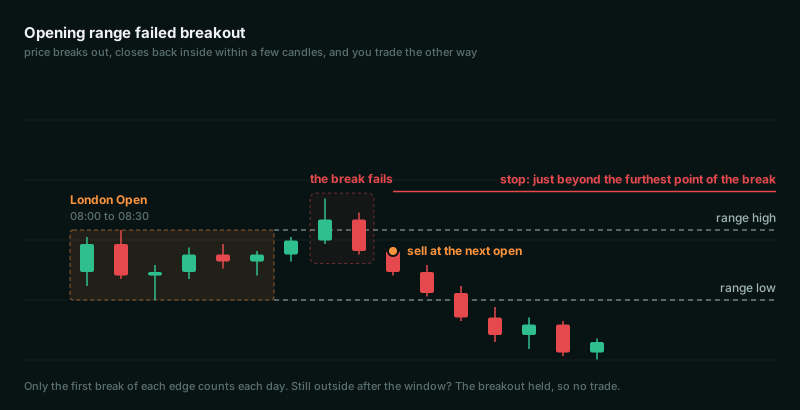
The rules mirror the breakout:
- Price trades outside the range. You decide whether a wick is enough, or whether a candle has to close outside
- A candle closes back inside within a set number of candles
- You trade the other way at market, on the next candle's open
- The stop goes just beyond the furthest point of the failed break
- Only the first break of each edge counts each day. If price is still outside when the window runs out, the breakout held and there is no trade
Whether the breakout or the fade works better on your instrument is not something to settle by opinion. It is one of the most useful comparisons you can run, because both trade the same range on the same days.
How the Raw Edge ORB card works
In Raw Edge the opening range breakout is a ready-made setup. On the Strategy Chain tab, press + Add Indicators & Conditions, and you will find Opening Range Breakout under Structure in the Conditions list. Select it and press Add to chain.
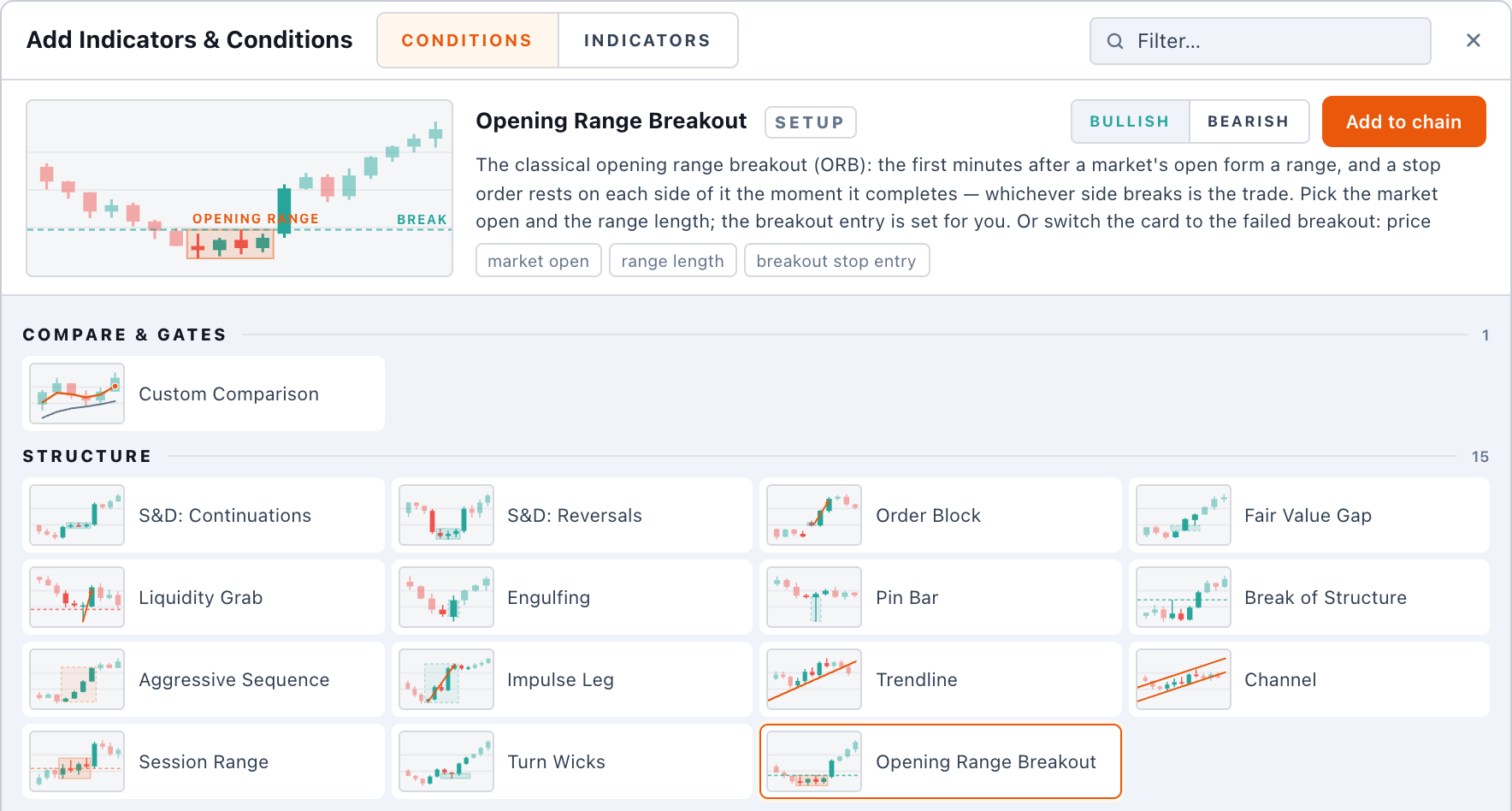
That adds the Opening Range Breakout card, with five settings:
- Trade. The breakout, or a failed breakout, where you fade it.
- Market open. New York 09:30, London 08:00, Frankfurt 09:00, Tokyo 09:00, Hong Kong 09:30, or a custom time.
- Opening range length. The first 15, 30, 45, 60 or 90 minutes.
- Keep the breakout order working. For the rest of the day, until the London close (16:00 UTC), until the New York close (21:00 UTC), until the Asia close (08:00 UTC), or for a set number of bars.
- Bias. Both sides, whichever breaks first. Or long only, or short only.
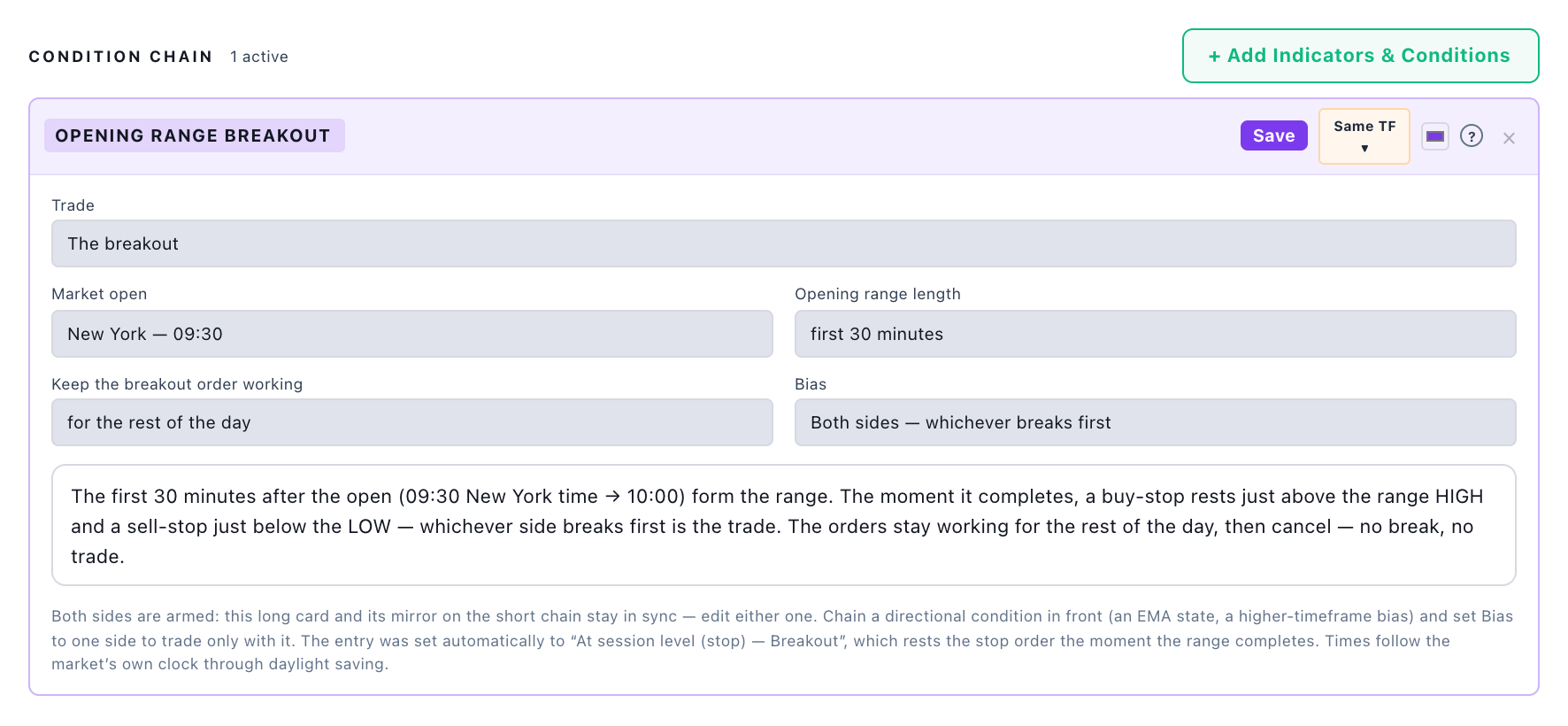
Under the settings, the card spells out in plain English exactly what will happen: when the range forms, where the orders rest, and when they cancel. Change a setting and the sentence changes with it.
The note at the bottom of the card covers the rest:
- With Bias on both sides, the card on the long chain and its mirror on the short chain stay in sync, so you can edit either one
- The entry is set for you, to a stop order at the session level, which rests the moment the range completes
- Times follow the market's own clock through daylight saving
- To trade one direction only, chain a directional condition in front, such as an EMA state or a higher-timeframe bias, and set Bias to that side
Switch Trade to the failed breakout and the card becomes Opening Range Failed Breakout. Two more settings appear: What counts as a break (price trading outside the range, where a wick is enough, or a candle closing outside it) and Must close back inside within, a number of candles. The entry changes to market, on the next candle after the one that closes back inside, and the card suggests a stop just beyond the furthest point of the failed break, with a Use that stop button to apply it.
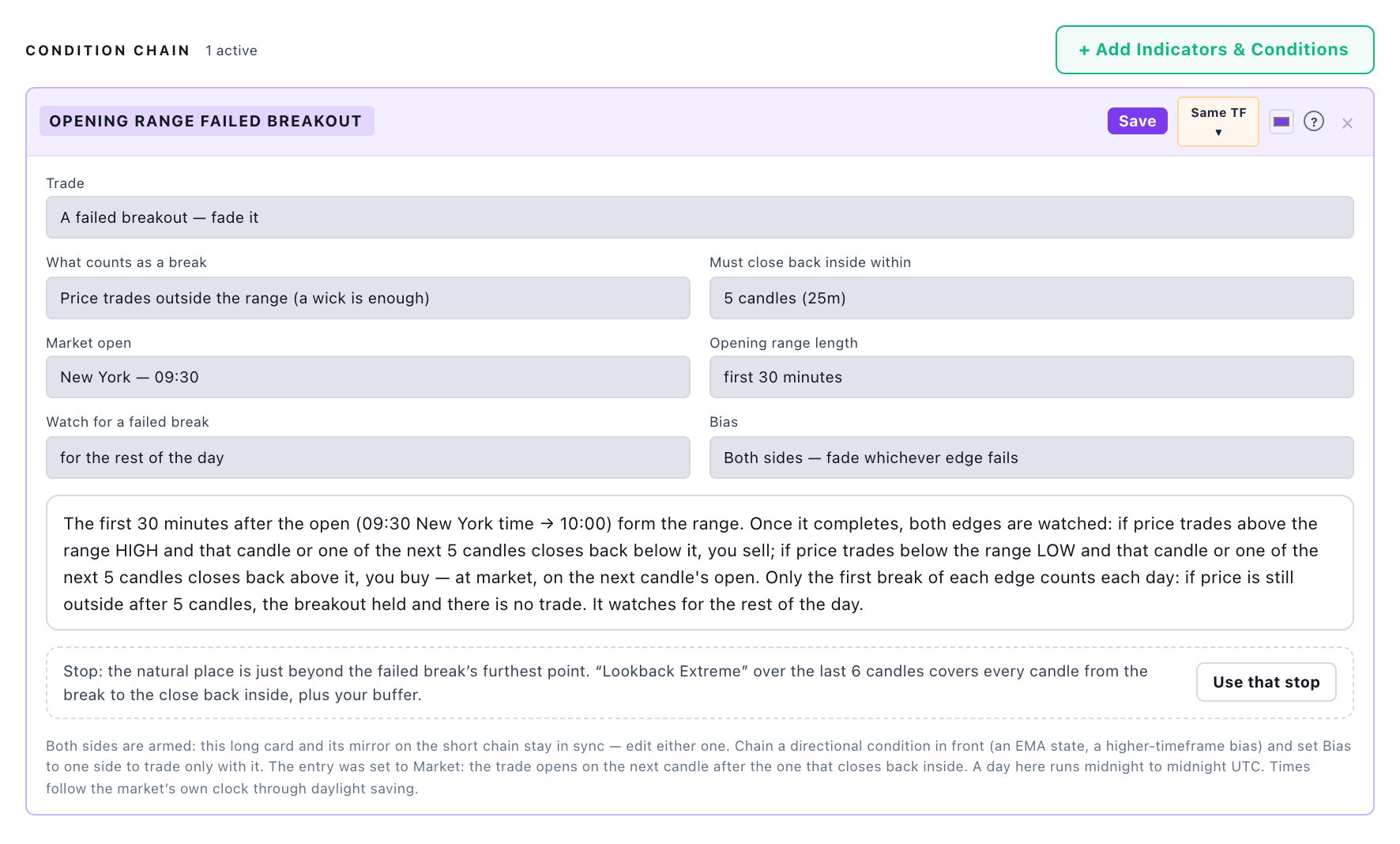
For the breakout itself, the classic stop on the other side of the range is set on the Entry tab: choose Lookback Extreme and set it to the number of candles in the range, which is six on a 5 minute chart for a 30 minute range.
Why Raw Edge is the better place to run an ORB
Every problem in the details section above is handled for you, rather than left for you to notice.
- It trades the order you would actually place. The stop order is working from the moment the range completes, so breaks on the very first candle after the range count, and the backtest fills on the level as price trades through it, the same way a broker fills a resting stop. Deploy the strategy and it places the same pending orders on your MT5 account.
- The open follows its own clock. Each market open tracks its own city's daylight saving, so 09:30 in New York is 09:30 in New York in January, in July, and through the weeks when the US and UK clocks disagree.
- The bracket behaves like a bracket. With both sides armed, the first fill cancels the other order, in the backtest and live. If a single candle touches both edges, the one nearer that candle's open is taken as first, so a wild candle is never booked as two trades.
- No code, and no guessing what the code does. A proper ORB Expert Advisor has to handle time zones, pending orders, expiry and one-cancels-the-other logic, and every variation means another round of programming. Here it is one card, and the sentence tells you what it will do.
- Filters are easy to add. Chain a directional condition in front of the ORB, such as an EMA state or a higher-timeframe bias, and set Bias to that side to trade only with it. Breakouts in the direction of the bigger trend are one of the first things worth testing.
- Honest costs at the most expensive time of day. Backtests run on your broker's own prices, with their measured spread applied per bar, so a fill at the open is charged the wider spread that really existed. Slippage and swap are modelled too. Commission is the one cost you set yourself: it defaults to zero, so enter your broker's rate before you trust a result.
- You can see where it works. The Sessions and Time Breakdown view shows which hours made the money, the Regime view splits trending markets from ranging ones (exactly the split an ORB lives or dies by), and the Forward Test shows how the strategy did on the most recent stretch, held back from the rest. Changing the open or the range length is a dropdown and a re-run, and the Trade Optimiser sweeps stops, targets, trailing, timeframes and instruments in one go.
- What you tested is what goes live. Send the strategy live from the Stats tab, either to trade automatically or as Signal Only alerts you act on yourself. It keeps running with your computer switched off.
A sensible way to test an ORB
- Start with the classic: one market open, a 30 minute range, both sides, the stop on the other side of the range and a 2R target
- Set your broker's commission before running anything
- Run it, then open the trade list and check the first ten trades against the chart. Every fill should sit on the range edge, at the right time of day
- Try 15 and 60 minute ranges, and look for a length whose neighbours also hold up
- Run the failed breakout on the same market and compare
- Add one filter at a time, such as a higher-timeframe trend, and keep it only if it improves the result rather than just cutting the trade count
- Check the Forward Test, then run it on a demo account before risking real money
The opening range breakout has lasted for decades because the idea behind it is sound: the open is where the day's argument starts, and a clean break tells you who is winning it. Whether it pays on your market, at your broker, with your costs, is a question a backtest can answer, as long as the backtest trades the same order you would. That is what the ORB card is built to do.
Test it before you trade it
Raw Edge lets you build strategies visually, backtest them with realistic spread and commission, and deploy the same logic straight to MetaTrader 5.
See pricingMore reading
- Repainting Indicators: Why Your Strategy Tests Well and Trades BadlyWhat repainting is, why so many indicators quietly rewrite their own history, how to test any tool for it — and how Raw Edge is built so signals stay put.
- Backtesting Smart Money Concepts: Order Blocks, FVGs and LiquidityHow to turn order blocks, fair value gaps, liquidity sweeps, BOS and CHoCH into precise, testable rules — and find out whether your SMC idea actually works.
- MT5 Backtesting Software: How to Test a Strategy ProperlyA practical guide to backtesting software for MetaTrader 5 — data quality, spread and commission modelling, sample size, and out-of-sample testing.